Honors College Profiles

Who are current NAU Honors students?
 Brock Schroeder
Major: Political Science and Anthropology
Grad Year: 2021
“I am happy to report I have been accepted into Arizona State University’s Master of Public Administration program. It is my goal to take the education and skills gained from this program to work in local government in a city management capacity.”
Read more about Brock’s experience in Honors Accordion Closed
“I value the support system, the interactive coursework, and the opportunities that I have had as an NAU Honors student. Though for me the best thing about my Honors experience was not these items but rather the connections that I have had the privilege of making. In the NAU Honors College, I was exposed to many intelligent and highly talented individuals; individuals who I am glad to have sat next to at lectures, chatted after class, and personally worked with on a multitude of projects. These people, who share the title Honors student are not simple academics but future teachers, analysts, engineers, and scientists. The fact that I was able to work with and learn from such a diverse group is what I most value about my brief tenure here at NAU.”
 Brianna Cartwright
Major: Biomedical Science
Grad Year: 2021
“The honors capstone has been a rewarding experience as I was able to further expand my knowledge and passion for dentistry. The honors college has given me the opportunity to address an important issue in dentistry and prepare me for the rigors of dental school.”
Read more about Brianna’s experience in Honors Accordion Closed
“My Honors Capstone project is about educating the public on a common problem in dentistry: patients experiencing anxiety and fear of visiting the dentist. In dentistry, there are many patients who do not receive proper dental treatment because they avoid the pain and fear of visiting the dental office. I will present at the NAU Undergraduate Symposium the research I have discovered as far as how the field of dentistry is attempting to help patients who are fearful of the dentist. By presenting my research, my intentions are to educate the public and dental community about how to help patients with dental anxiety get the treatment they need. From biofeedback to anesthetics to dental devices, there are many different ways that the fear and anxiety of dental patients can be reduced in order to get patients the proper treatment they need.”
“After graduation, I am attending dental school at the University of Colorado School of Dental Medicine in Aurora, CO. After four years of dental school, I aspire to specialize in pediatric dentistry or orthodontics. Once I have specialized, I plan to open up my own dental practice and treat patients with dental anxiety.”

Madison Little
Major: Biomedical Science and Chemistry
Grad Year: 2021
“My capstone project in combination with my coursework at NAU helped me to find my passion for chemistry and its applications in biology, steering me towards pursuing chemical engineering. I have since been accepted into several chemical engineering graduate programs with biologically applicable research focuses. I will be attending Washington State University in the fall as a PhD candidate and an NIH Protein Biotechnology Trainee.”
Read more about Madison’s experience in Honors Accordion Closed
“My Honors Capstone was composed of three credits earned from a summer study abroad course, and three credits earned in an honors section of a biomedical science capstone class, Medical Microbiology. In the summer after my sophomore year I attended a course titled “Medical Biotechnology and Drug Development” in Denmark and Scotland. During this class I was exposed to people with backgrounds in all kinds of science: chemistry, biology, physics, medicine, and more. It was there that I came to realize that science is interdisciplinary and each specific subject relies on the others for a full understanding. I wrote several reflective papers on the content of the course, my personal experiences abroad, and my academic growth to earn the capstone credit. My capstone project in combination with my coursework at NAU helped me to find my passion for chemistry and its applications in biology, steering me towards pursuing chemical engineering. I have since been accepted into several chemical engineering graduate programs with biologically applicable research focuses. I will be attending Washington State University in the fall as a PhD candidate and an NIH Protein Biotechnology Trainee.”
Being a part of the Honors College has been a great experience and has benefited me in several ways over the last four years. The smaller class sizes have allowed me to form strong relationships with both students and faculty that have been especially influential in my undergraduate career. In addition, the writing- and presentation-based nature of the Honors College has helped prepare me for a graduate level education where I will be presenting research to colleagues and authoring papers of my own. I am incredibly glad that I was part of the Honors College for my time at NAU. Next up, Washington!”

Clare Henry
Major: Public Health
Grad Year: 2021
During her time at NAU she studied abroad in Tanzania, worked as a peer health educator in the Office of Health Promotion, and presented independent research regarding the criminalization of substance use disorders at the Honors Fall 2020 Virtual Symposium
Read more about Clare’s experience with Honors Accordion Closed
Clare Henry, a Senior from Mukilteo, WA, will be graduating Summa Cum Laude this May with a degree in Health Sciences: Public Health. During her time at NAU she studied abroad in Tanzania, worked as a peer health educator in the Office of Health Promotion, and presented independent research regarding the criminalization of substance use disorders at the Honors Fall 2020 Virtual Symposium. Currently, she is serving as an intern for a State Senator in the Washington State Legislative Internship Program. Upon graduation in May 2021, she is planning to attend law school where she will concentrate in public interest law. So far, she has been accepted into the University of San Francisco School of Law and offered the Dean’s Scholarship Award, but is still waiting for admissions decisions from other schools.
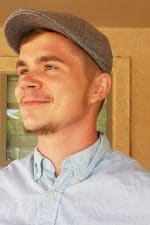
Joseph Vargovich
Major: Computer Science
Grad Year: 2021
“My Honors College experience has developed me into a well rounded academic, rather than a narrowly focused STEM student. I noticed that my writing skills are superior to Computer Science students who have not completed the Honors College. This has been an invaluable skill as I lead my Capstone team and deliver important software documents. Additionally, the Honors College has gone above and beyond to support my ambitions of becoming an emotionally intelligent technical leader in industry. I highly recommend the Honors College to any student, regardless of major, as it provided me with an academic environment focused on my personal academic growth and success as a leader”
Read more about Joseph’s Honors College experience Accordion Closed
“My Honors Capstone project is an extension to my “Gamified Mobile Pronunciation Tutor For Language Learners” Computer Science capstone project. This application teaches English as a Foreign Language (EFL) learners key aspects of verbal conversation through repeated practice and Automatic Speech Recognition (ASR) feedback on recorded speech. My Honors Capstone centers on the implementation of video-based learning tasks that allow EFL students to view and respond to true English language conversations. These video perception tasks allow learners to observe key aspects of conversation, such as body language and nonverbal communication, in order to become emotionally intelligent English speakers.”
“My plans post-graduation are to continue onwards with a Master’s degree in Computer Science at NAU, as well as completing a summer internship with PetSmart on the Mobile App Development team. I have received an offer for a graduate research assistantship from Dr. Marco Gerosa, my former software engineering professor. Thus, I seek to contribute to and publish research in the field of software engineering throughout my graduate studies in collaboration with Dr. Gerosa and his lab. Post grad-school, I hope to lead a team of software engineers in a tech-focused company. I believe that a Master’s degree will be a vital part of attaining this goal of technical leadership.”
Who are our NAU Honors alumni?
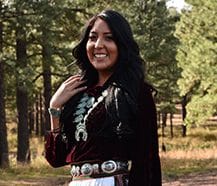
Emile Eich
Psychological Sciences, Class of 2019
Miss Indian NAU 2017
Graduated from Centennial High School in Phoenix
“NAU Honors has made my college experience feel like an adventure.” I’ve taken Honors class trips along the Colorado River and San Juan River with faculty Ted Martinez and Robyn Martin. These trips are so much more intimate and amazing than just reading about places you have never been.
Read more about Emile Accordion Closed
Honors offers small classes which has enabled me to get to know my professors better get more feedback about my writing. I chose Honors at NAU because I wanted to meet like-minded people that were serious about their education and want to learn more about the world.
As Miss Indian NAU I have a responsibility to promote cultural awareness and understanding of tribal/indigenous nations, support NAU’s Native American student organizations, and participate in programs that strengthen the retention of Native American students. I serve as a role model and leader to students at NAU and middle/high school students in Flagstaff and on the nearby reservations.
Read more about Emile’s journey at NAU here:
Graduate Emile Eich: As Miss Indigenous NAU, she found her identity and her passion
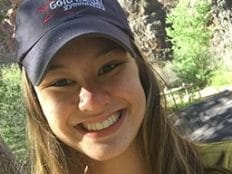 Jacqueline Lyman
Biology and Spanish, Class of 2020
Studying abroad in 2019-2020
Loves backpacking in the Grand Canyon
“I chose Honors at NAU because I wanted to be a part of a close-knit community of ambitious students. I’ve met some of the most incredible and inspiring students and faculty here, and I attribute that to the unique learning environment that the Honors College provides.” I highly recommend the NAU Honors College for any student looking for a rigorous and personalized education while receiving the benefits of attending a large university. I grew up in the Phoenix area, and I can say the commute to Flagstaff is a welcomed escape, Flagstaff truly feels like a world of its own.
Read more about Jacqueline Accordion Closed
I found the Honors College to be the perfect combination of small, focused classes and extensive university resources. Being an Honors student has definitely changed my outlook and perspective on college. I never thought I could experience such a friendly and intimate atmosphere at a large university. Honors faculty are different from traditional university professors because they strive to cover materials beyond the surface level understanding and aim to reach more in depth, analysis based conclusions. The Honors classes that I’ve taken encouraged me to go above grasping general concepts, and inspired me to think critically and ask probing questions of my peers and myself.

Desirae Enriquez
Biomedical Science with minors in Chemistry and Psychology, Class of 2019
Lived in Honors Residence Hall, Ernest Calderón
From Rancho Cucamonga, California
“I chose Honors at NAU because I was impressed with the opportunities and resources that are provided to help us achieve our academic goals. I knew that Honors at NAU would give me the time, attention and material needed to further my education.”
Read more about Desirae Accordion Closed
Honors hosts social programs such as BBQ’s, coffee and hot chocolate study nights, donuts and coffee enrollment mornings, stress busters, trips to the Grand Canyon, camping trips and much more. These programs helped me meet more Honors students who had similar goals as mine and introduced me to some of my best friends today.
What Desirae loves about Honors at NAU:
- Presentations that provide a broad outlook on world issues
- Small class size allows a personal connect with professors and feedback on assignments
- Free in-hall tutoring
- Honors writing center
Honors faculty have helped expand my thought process and taught me how to look at issues in a more diverse, analytical and debatable way. Honors classes are taught in a manner where it is not only interesting and fun to learn but also connects students with a further outlook on every day material around us.