Warm Fire
Background
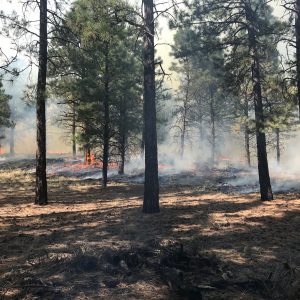
On June 8th, 2006, a lightning strike ignited
the Warm Fire on the northeastern edge of the Kaibab Plateau. The Kaibab National
Forest had recognized the need to manage fire and fuels at a landscape-scale and
developed a Wildland Fire Use (WFU) program with the Warm Fire being the first large
implementation of that plan. The fire was initially managed as a WFU fire where
it burned with a mix of low, moderate and high severity fire across approximately
7900 ha (19,500 acres) of predominately ponderosa pine forests (USDA 2007). The
initial plan was altered on June 25th, when weather conditions changed considerably,
and the Warm Fire exceeded its maximum manageable area and was declared a wildland
fire. The wildland fire portion of the fire was predominately high severity, but
did burn in low and moderate severity and burned in all three vegetative types:
mixed conifer forests, ponderosa pine forests and pinyon juniper woodlands. In total,
the fire burned 24,000 ha (59,000 acres) with several very large high severity patches.
The Warm Fire served as the first large application of the WFU program and had unintended
consequences which resulted in controversial second-guessing of fire policies within
northern Arizona and especially across the North Kaibab ranger district. Fire suppression
and post-fire rehabilitation was done in the moderate and high severity burn areas
of the wildfire section. Post-fire mitigation consisted of seeding with ryegrass
for the purpose of reducing flood risk, soil erosion, and invasion of non-native
plant species.
This portion of the study falls into two sections of the study and addressed two
of the main objectives:
A. Fire severity effects on the overstory composition and structure, understory
vegetation and fuels
1. Characterize understory vegetation response to fire and determine correlation
between fire severity, physiographic variables, and changes in understory vegetation
characteristics.
B. Post-fire rehabilitation effects on understory vegetation
2. Characterize understory vegetation response to post-fire seeding.
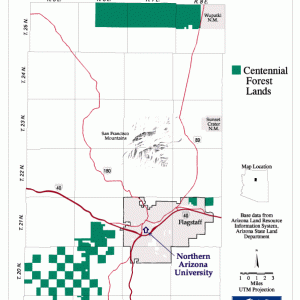
Our study was located in the Warm Fire on the Kaibab Plateau in the Kaibab National
Forest in northern Arizona, USA (Fig. 1). Plot locations range in elevation from
2300 to 2590 m and at the landscape-scale have a similar disturbance history in
terms of grazing and logging. The fire burned across three vegetation communities:
higher elevation mixed conifer; mid-elevation ponderosa pine dominated interspersed
with quaking aspen and lower elevation pinyon-juniper woodlands. This study was
conducted in ponderosa pine dominated overstory with an understory composed of common
grasses, such as muttongrass, squirreltail, and Junegrass and common forbs including
small leaf pussytoes, Fendler's sandwort, and woolly cinquefoil.
Figure 1. Location of study site. Perimeter of the Warm Fire; the northern portion
of the fire (no crosshatch) was managed as a WFU while the southern portion (crosshatched)
was managed as a wildfire and was subjected to post-fire mitigation. The fire encompassed
24,000 ha across three vegetation types. Burn severity is indicated by varying shades
of grey. Unburned controls are indicated by green circles, low severity plots by
blue triangles, high severity non-seeded by yellow squares, and high severity seeded
plots by red circles.
We sampled a total of 102 plots in 2008 and 2009 with 25 unburned controls; 27 low
severity; 25 high severity non-seeded; and 25 high severity seeded. We sampled understory
plant cover, biomass, species richness, and species composition during August and
early September. We measured forest floor cover by estimating cover of bare soil,
rock, wood, litter, duff, lichen, moss, and scat. Overstory canopy cover was measured
with a densitometer in 2009 by counting the number of overstory hits at 33 points
along the transect lines. Topographic variables recorded at each site were slope
(degrees), aspect, and elevation (m).
Key findings
A. Fire severity effects on the overstory composition and structure, understory
vegetation and fuels
1. Characterize understory vegetation response to fire and determine correlation
between fire severity, physiographic variables, and changes in understory vegetation
characteristics.
Fire in ponderosa pine forests stimulates the growth and diversity of the understory
plant community. We observed this trend in our study as vegetation cover, biomass
and species richness increased with increasing fire severity. High severity plots
averaged the highest vegetation cover, biomass and greatest species richness with
low severity plots a close second in species richness. There was however, a lack
of response in vegetative cover and biomass in the low severity plots. We attribute
this to the unnatural accumulation of litter and duff from lack of fire in the last
century. We saw that as litter cover increased, total vegetative cover and biomass
decreased and conversely, when soil cover increased, so did vegetative cover and
biomass. On low severity sites litter cover was still 53% two years post-fire while
high severity sites had only 32% cover. Decreasing unnaturally high levels of litter
through fire creates an opportunity for understory growth. Comparisons of pre-fire
data collected on 16 of the plots indicate similar plant composition and structure
to our unburned controls. When the community is separated into functional groups,
we observed that the pre-fire cover of graminoids, forbs and shrubs is most similar
to the unburned controls and low severity plots in 2009. Exotic species also appeared
to represent about 10% of the total species in the pre-fire community.
The
plant community composition was significantly different between all three treatments;
unburned, low severity and high severity sites. The differences in the community
were primarily driven by factors of fire severity: litter cover, canopy cover and
exposed soil/rock. Indicator species analysis showed significantly more annual and
biennial forbs strongly associated with high severity and perennial forbs and trees
as indicators of unburned controls and low severity. There were 23 species associated
with high severity and of those 18 are annuals/biennials, 5 exotics, and 9 ruderals.
Reference sites in ponderosa pine forests on the North Rim of Grand Canyon National
Park that have not been subjected to fire suppression indicate that annual and biennial
forbs are of great importance to the post-fire plant community for species richness
and vegetative cover. Overall, we observed greater frequency and abundance of exotics
as fire severity increased (unburned, low severity and high severity) and the total
cover of exotics was less than 2% for all three treatments. Prickly lettuce, yellow
salsify, and dandelion were consistent in high severity plots but had low average
cover (<1%). All three species are listed as noxious weeds in at least one state
and are well adapted to disturbed areas as they are prolific seed producers with
wind-dispersed seeds that can colonize from off-site. Cheatgrass and mullein were
also more prevalent in high severity sites and cheatgrass in particular should be
monitored to prevent spread across the landscape. Overall, we observed greater changes,
both positive and negative within the high severity burn areas.
B. Post-fire rehabilitation effects on understory vegetation
2. Characterize understory vegetation response to post-fire seeding.
Total vegetation cover is used to determine the success of seeding and a recent
review of published seeding studies concludes that while seeding is a common choice,
it is not effective at producing the required 60% ground cover to reduce the amount
of bare soil and prevent erosion and exotic invasions. The results of this study
support this review in that the seeded species averaged only 6% cover one-year post-fire
and seed was most prevalent on gradual slopes. Seeded sites actually had less total
cover and biomass than non-seeded sites in the Warm Fire although it was not a significant
difference in either case. Bare soil was also significantly higher in seeded sites
hence seeding was not effective at decreasing the exposed bare soil. Seeded areas
also did not differ significantly from non-seeded sites in the cover of exotics
species and the impacts of seeding appear to be relatively marginal on that front
as well. The presence of cheatgrass in both seeded and non-seeded plots increased
from 43% of all plots to 50% in 2009 with no significant difference in cover between
treatments. Cheatgrass cover is low (< 2%) but the observed increase warrants
concern and continued monitoring is strongly recommended. Ryegrass was still present
across the landscape 3 years post-seeding and while the percent cover is decreasing,
the presence of an exotic species occupies species space and usurps resources that
would otherwise be available for native plant species.
The plant community composition was significantly different between seeded and non-seeded
sites as confirmed by both statistical analysis and ordinations and the differences
associated with seeding are disconcerting. Although ryegrass cover was relatively
low, there is evidence that it competes for space and may displace natives thus
altering the initial community composition and possibly the community trajectory.
The presence of ryegrass was associated with significantly less cover of three dominant
native bunchgrasses (squirreltail, mountain muhly and muttongrass) and less cover
annual and biennial forbs cover in seeded plots. Annual and biennial forbs play
an important role in post-fire restoration as they add significantly to the species
richness and vegetative cover in burned areas in ponderosa pine forests on the Kaibab
Plateau. We also observed significantly fewer ponderosa pine seedlings in seeded
sites and acknowledge that this may be due to environmental variation as well as
propagule pressure. We analyzed of the rate of plant community change in a treatment
between years and results indicated that these communities are changing at similar
rates, but potentially in different directions as per our indicator species analysis.
Analysis of biomass data reflected similar trends with less biomass of native bunchgrasses
and fewer annual and biennial forbs as indicator species in the seeded plots. The
long-term persistence of this intentionally introduced ryegrass is currently unknown
and managers and stakeholders will need to continue monitoring.
Last Updated ( Tuesday, 15 March 2011 )