Carbon Flux Research
Our research team from Northern Arizona University is investigating impacts of ecosystem disturbances and forest management activities
on fluxes of CO2, water, and CH4 in forests dominated by ponderosa pine (Pinus ponderosa),
the most widely distributed pine in western North America.
Sites
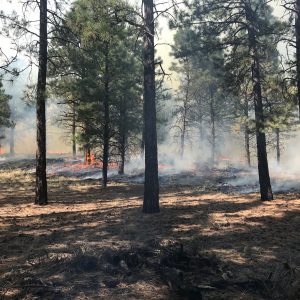
Our research is unique in establishing flux tower sites in forests recently exposed
to stand-replacing wildfire and restoration, fuel reduction treatments that represent regionally
distributed processes affecting landscape-scale carbon flux. We are using 3 sites:
- Control: Unmanaged (C)
- Restored: Thinned + prescribed-burned (R)
- Wildfire: Burned ponderosa pine forests (W)
Research questions
The project is addressing the following questions:
- How do stand-replacing wildfire and forest restoration treatments influence fluxes
of
CO2, water, and CH4?
- How do major components of
CO2 flux differ among unmanaged, restored, and wildfire-burned
forests?
- How does annual net ecosystem exchange (NEE) of
CO2 estimated with the eddy covariance
approach compare with net ecosystem production (NEP) of carbon estimated with the biomass
inventory approach?
- How are fluxes of
CO2, water, and
CH4 influenced by intra- and inter-annual variation in
a region with a highly variable climate?
Funding
This project has been funded by:
- North American Carbon Program
- USDA/AFRI National Research Initiative
- National Science Foundation, Major Research Instrument Program
- Mission Research Program, School of Forestry, Northern Arizona University
- (McIntire-Stennis/AZ Bureau of Forestry)
- Arizona Water Institute
- Science Foundation Arizona
- NAU ERDENE